digital-transformation
The Old Formula for Making Money Is Broken. Here's What Replaced It.
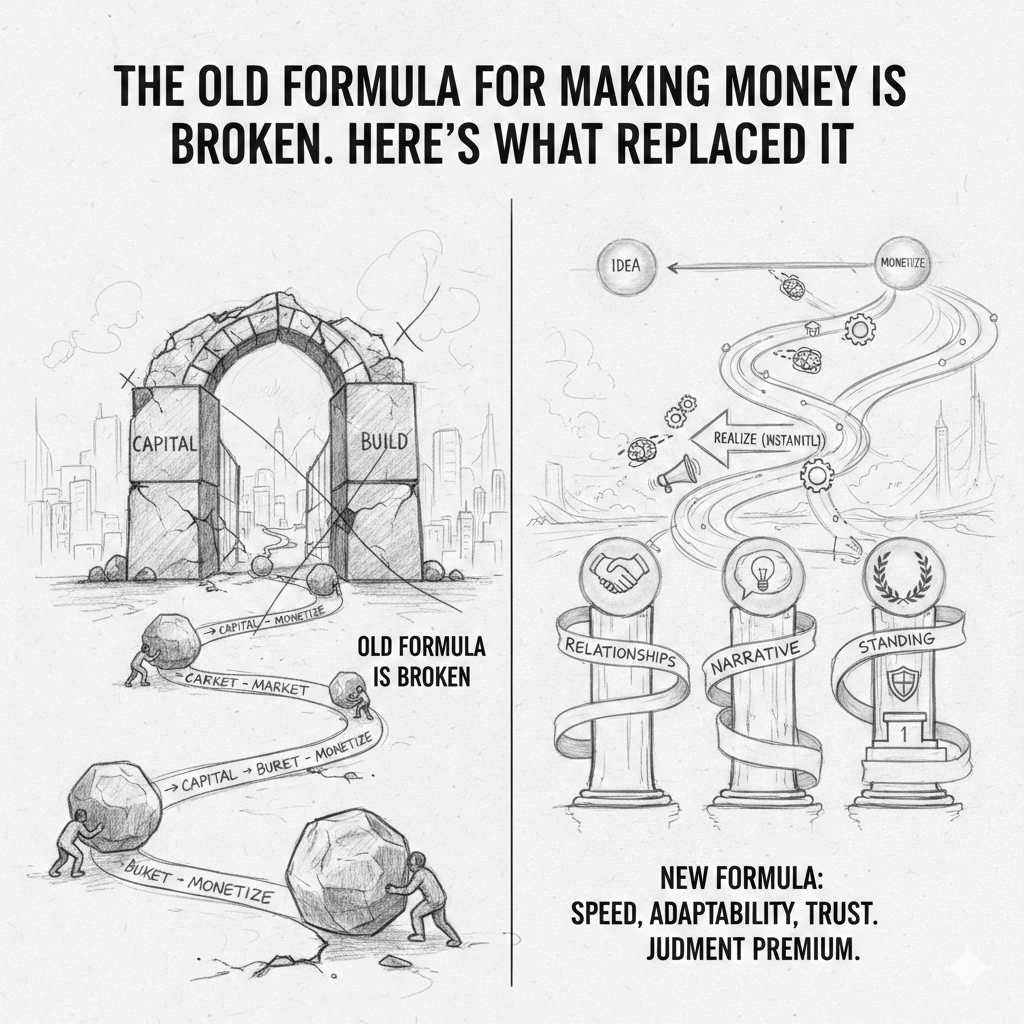
For decades, turning an idea into revenue followed a predictable sequence: Idea → Capital → Build → Market → Monetize.
Capital and building were the hard parts. They were the gates. And if you were in the business of helping people get through those gates — as a consultant, a developer, an agency — that's where your fees lived.
That formula is collapsing in real time.
The gap from idea to realization just closed
In 2021, a minimum viable product took three months and $50,000 to $150,000. Today, a solo founder with the right tools can build, test, and deploy a functional SaaS over a long weekend for the cost of an API subscription.
This isn't speculative. The data is stacking up fast. By end of 2025, an estimated 41% of all code written was AI-generated. Over 84% of developers were using or planning to use AI coding tools, with 51% using them daily. McKinsey found 62% of organizations experimenting with autonomous AI coding agents — not copilots that suggest a line of code, but agents that execute multi-step development tasks end to end.
The term Andrej Karpathy coined for this — "vibe coding" — became Collins Dictionary's 2025 Word of the Year. That's not a niche developer trend. That's a cultural shift in what it means to build something.
And it's not just startups feeling this. McKinsey itself has reduced client project team sizes from 15+ to 4, with automation replacing junior layers. They've deployed 12,000 AI agents across the firm for research, slide production, and logic checks. 40% of their revenue is now linked to AI and tech-related advisory work, restructured around outcomes, not billed hours.
When even the world's most elite consulting firm is dismantling the build-and-bill model from the inside, the signal is unambiguous.
The old bottleneck was capital and capability. The new bottleneck is judgment.
Think about what used to stand between an idea and its monetization. Two things: the capital required to build it, and the awareness required to market it.
Capital was the filter. You needed funding to hire a team, buy infrastructure, and survive long enough to ship something. If you couldn't raise, you couldn't build. If you couldn't build, you couldn't compete. The entire venture capital ecosystem existed to sit at this chokepoint.
Awareness was the second gate. Even if you built something great, distribution was expensive. You needed ad budgets, sales teams, channel partnerships — all of which demanded more capital.
Both gates have swung open.
AI-assisted development tools can cut prototype costs by 40–60%. Cross-platform frameworks like Flutter let a single codebase ship to both iOS and Android. Pre-trained models handle NLP, vision, and classification tasks out of the box. A founder in 2025 can validate demand for the cost of a used car.
On the distribution side, organic reach through social platforms, product-led growth mechanics, and community-driven launch strategies have made awareness achievable without seven-figure marketing budgets.
So if building is cheap and distribution is accessible, what's left?
Speed, adaptability, and trust
When everyone can build, the bottleneck moves upstream. The scarce resource is no longer "who can execute" — it's "who knows what to execute, and why."
This is where the consulting industry's own transformation becomes instructive. A Fast Company analysis of McKinsey's recent workforce cuts framed it bluntly: the source of value in consulting is "shifting decisively." The analytical horsepower that firms built their reputations on — synthesizing data, generating recommendations — is being commoditized by AI. What remains valuable is the human judgment that AI can't replicate.
The same principle applies to any business that previously charged for building. Whether you're a software consultancy, a digital agency, a systems integrator, or an internal product team, your billing model was anchored to the complexity and effort of construction. That anchor is dissolving.
But the other side of this shift is that if you're positioned correctly, you've never been more valuable. Because when building is commoditized, three things become the only durable competitive advantages:
Relationships — being in the room when the decision gets made. Not the pitch meeting. The decision. When a client's leadership is debating which direction to go and they want someone in that room they trust, that's the position that can't be automated, outsourced, or replicated by a tool.
Narrative — being the one who frames what to build and why. In a world where anyone can build anything, the person who can articulate what matters becomes the most important voice in the process. Not the developer. Not the project manager. The person who connects business reality to technical possibility and makes leadership confident in the direction.
Standing — being credible enough that people act on your recommendation. This is the cumulative result of consistently delivering judgment that proves right. It takes years to build and minutes to lose. And it's the one thing that cannot be shortcut by any technology, because it's earned through a track record of being right when it was hard to be right.
The new formula
The old formula — Idea → Capital → Build → Market → Monetize — rewarded those who controlled capital and build capacity.
The new formula is: Idea → Realize (nearly instantly) → Compete on speed, adaptability, and trust.
The winners in this formula don't charge less. They charge differently. They charge for knowing what the right thing to build is before a single line of code gets written. They charge for the speed of moving from insight to implementation while competitors are still scoping requirements. They charge for the credibility that makes a board or a C-suite act on a recommendation instead of commissioning another study.
For anyone running a consulting practice, an agency, or a product team: the revenue model built on construction hours is not going to zero tomorrow, but its trajectory is clear. The question isn't whether to transition. It's whether you're building the relationships, the narrative capability, and the standing that will be the basis of your value when that transition completes.
The build premium is ending. The judgment premium is just getting started.
Related articles
-

digital-transformation
Demand Planning with OE and Palantir
For many manufacturers, demand planning is still a broken process—fractured across teams, shaped by competing assumptions.
-

digital-transformation
AI Adoption Soars – Why Ontologies Are the Key to Enterprise AI Value
Part one of this research paper looks at the current state of AI. Part two explains what data ontologies are and how they provide context to enterprise data.
-

digital-transformation
AI Test Automation Tools
Discussing test automation is essential, as it has long been a challenge to implement for several reasons.